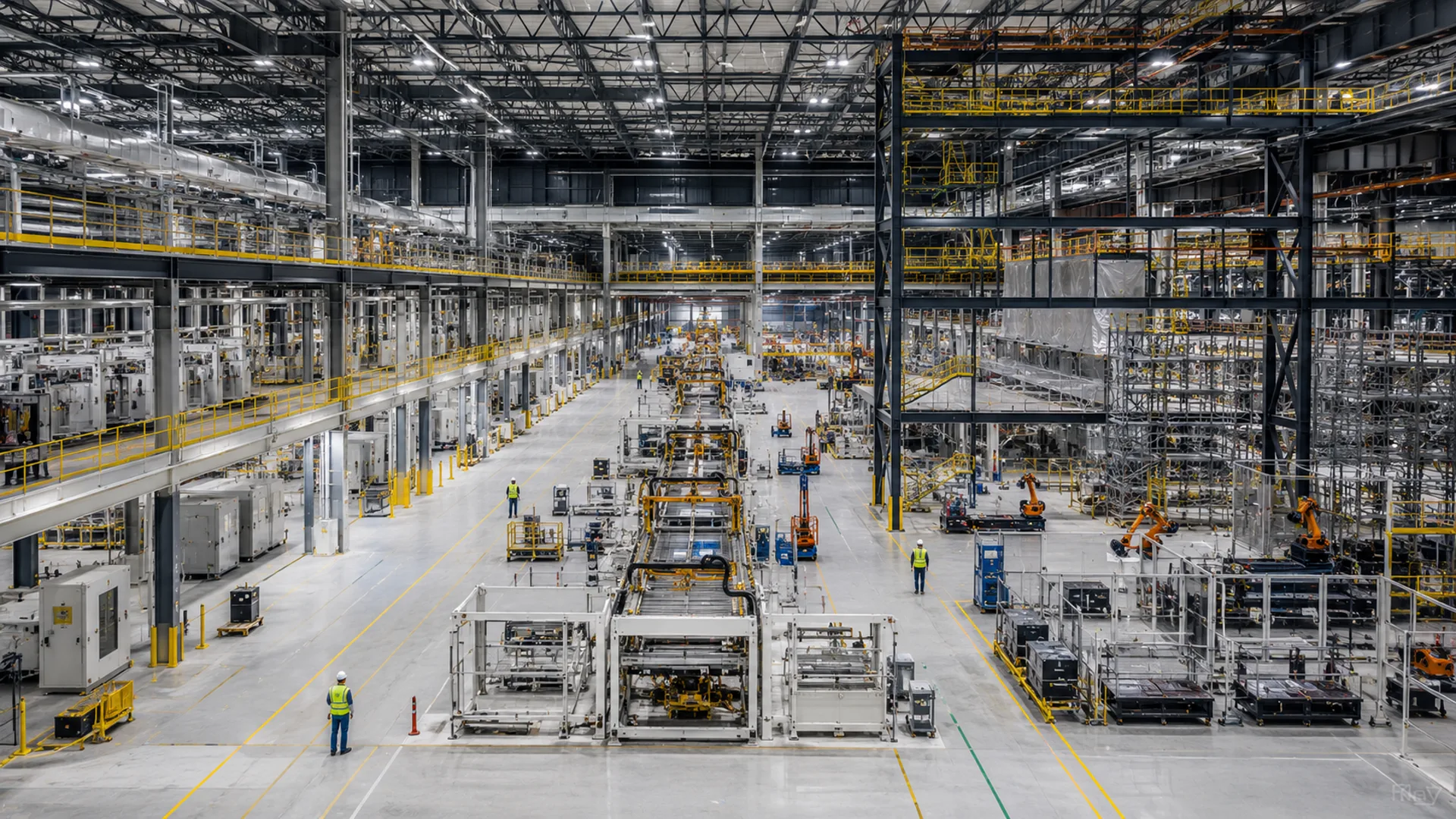
EV Battery Plant Construction Management
A Different Risk Profile Than Fab Vocabulary Suggests
Program management, commissioning, and owner's representation built around dry room construction, thermal safety, and chemical/mechanical/electrical integration as their own discipline.
Talk to Our TeamDry Room Construction
Dry room humidity specifications are far tighter than conventional industrial construction, and hitting them consistently requires construction sequencing and material selection decisions that first-time battery plant builders routinely underestimate — it's the spec that breaks projects carrying over fab or general manufacturing assumptions.
Chemical, Mechanical, Electrical: Where Battery Plants Actually Fail
Battery manufacturing integrates chemical process systems, mechanical handling, and electrical systems at the seams between disciplines — exactly where risk concentrates when program management doesn't treat that integration as its own coordination problem, not three separate scopes running in parallel.
Fire Protection Designed for Thermal Runaway
Lithium-ion production carries a fire and thermal-runaway risk profile with no real equivalent in semiconductor or general industrial construction. Fire protection design and commissioning has to be built around that specific risk, not adapted from a conventional industrial fire protection template.
Related Reading
Why Gigafactories Commission Differently Than Traditional Manufacturing Plants
Battery gigafactory commissioning behaves more like a semiconductor fab startup than a traditional manufacturing plant launch.
How to Choose an EV Battery Plant Construction Management Partner
Fab and battery plant construction share vocabulary but not risk profile. Here's what to ask before assuming a firm's advanced manufacturing experience actually covers your project.
Why EV Battery Plant Timelines Keep Compressing — and What That Does to Commissioning
Gigafactory schedules keep compressing for real competitive reasons — but that changes commissioning's sequencing, not whether it can be shortened.
Frequently Asked Questions
How is EV battery plant construction management different from semiconductor fab construction?
Battery manufacturing shares vocabulary with fabs — cleanrooms, tight tolerances — but the actual risk profile is different. Dry room construction, thermal runaway fire protection, and chemical/mechanical/electrical system integration are battery-specific disciplines that a fab-only construction management background doesn't automatically cover.
Why is dry room construction a common point of failure for first-time battery plant builders?
Dry room humidity specifications are far tighter than typical industrial construction, and the construction sequencing and material selection required to hit them consistently is easy to underestimate until a first attempt fails inspection. It's a spec that punishes assumptions carried over from conventional manufacturing builds.
Does EV battery plant commissioning carry over from semiconductor fab commissioning?
Partially — the underlying discipline of rigorous, independent, multi-tier verification transfers. The facility-specific risks don't: thermal runaway fire protection and dry room humidity control have no real equivalent in fab commissioning and have to be built as their own expertise, not assumed.
Build With a Team That Treats Battery Plants as Their Own Discipline
Not a fab or industrial team assuming the risk profile carries over.
Contact FusionIRX